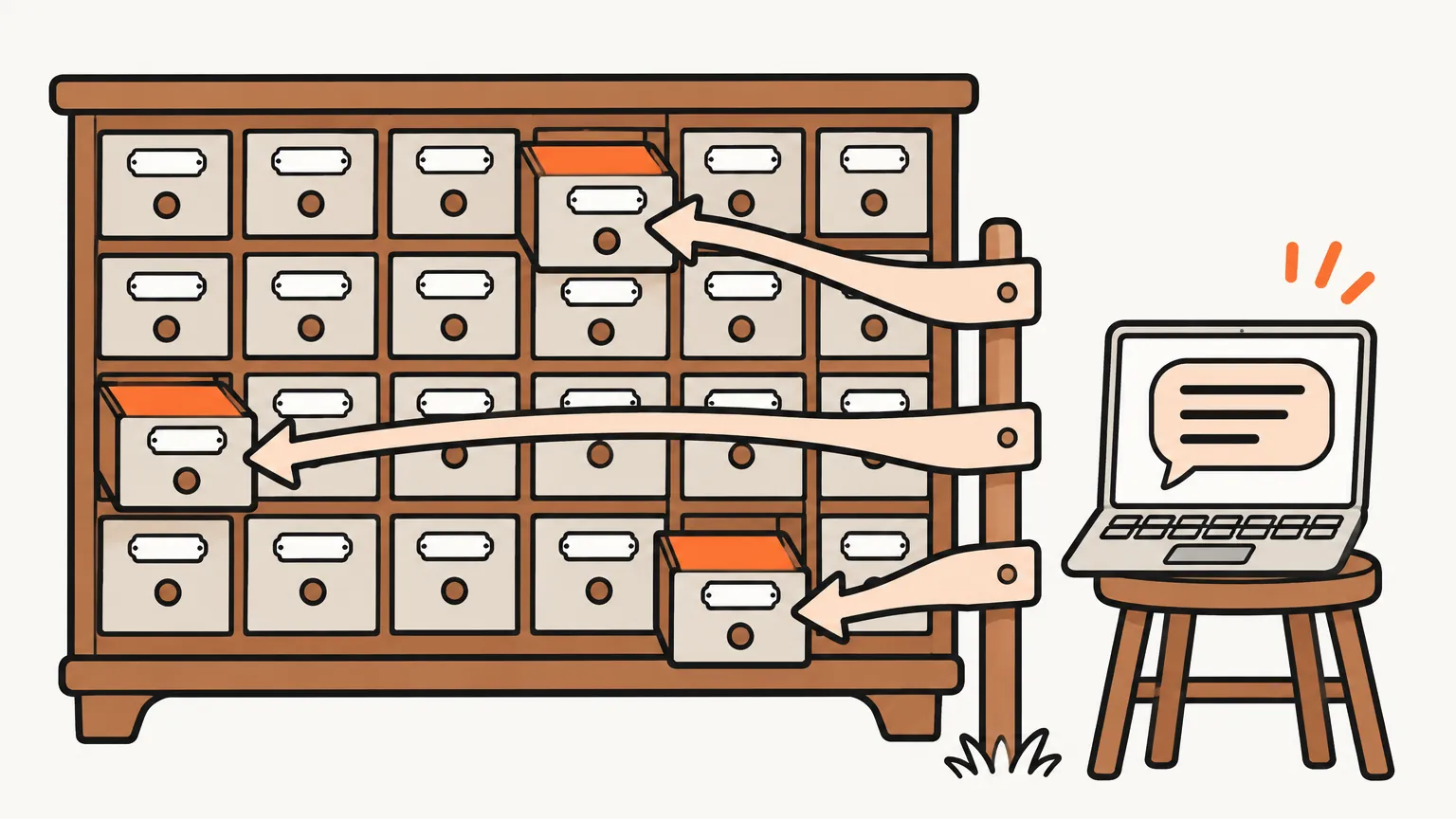
I write skills for everything I do more than twice: a skill for my static sites, one for my internal dashboards, one for SEO, one for TikTok carousels, one for bookkeeping, one for GitHub tickets. Some are mine, some come from plugins. Across my repos a session now sees between 80 and 95 of them.
I don’t remember their names, and I don’t want to. The whole point is that I say what I want and Claude picks the right playbook. Except my history kept showing messages like “use our skills properly, we have good ones now” and “use as many of our skills as you can, especially the motion graphics”. So I measured it.
The bench
I pulled every prompt I typed in the last 75 days, 4,370 of them, with the skills Claude loaded after each one. That shows what Claude did, not what it should have done, so the next step was a gold set: for each prompt, the skills that would actually change how it should be handled. Several are allowed, because a real request is rarely one thing. “Add a ticket to test the new research flow, then generate the two videos, use the motion graphics” needs three. About a third of the set needs no skill at all, so that a router firing on everything can’t look good.
Then I replayed those prompts through claude -p, same model, same skills, same hooks, each one in the directory it was typed in, against a copy of my config. A guard hook lets Claude choose skills and read files, and refuses everything else. The prompt that says “open a ticket and push” opens nothing and pushes nothing.
The baseline, on prompts I never tuned anything on: 57% of the needed skills loaded, and every needed skill in only half the requests.
What was not the problem
My first guess was the listing budget. Claude Code reserves a slice of the context for skill descriptions, and past it, the least used skills lose theirs and almost never fire again. It had bitten me twice, in October and November. With the budget raised, it was no longer the cause.
My second guess was bad descriptions. Partly true, and one finding was embarrassing: a project skill had a multi-line description with a colon inside, which is not valid YAML. Claude Code silently fell back to the title, so for a month that skill was announced to the model by its title alone.
But the clearest miss had a perfect description. “Check the Search Console notifications for the agency site, I think there are things to fix”: Claude loaded the browser skill and skipped the SEO skill, whose description contains “Search Console notifications” almost word for word. Claude reads every description, then weighs them against each other and against the rest of its context, and on that prompt the browser skill won.
What worked
A UserPromptSubmit hook that adds one or two lines to each prompt:
- The skills that match, in my words. One regex per skill, written from how I actually ask for things, not from the descriptions: “the GSC data”, “make it a skill”, “post it on X”, “what were our benchmarks”. Project skills are only suggested inside their repo. Each skill is named once per session.
- A reminder that a request often needs several skills, so Claude doesn’t stop at the first match.
| Held-out prompts, 2 passes | Without | With |
|---|---|---|
| Needed skills loaded | 57% | 84% |
| Requests with every needed skill | 52% | 82% |
| No-skill prompts left clean | 99% | 95% |
A third set, drawn after the last round of fixes, told the same story: 74% to 93%. And because a first message is the easy case, I also replayed 28 prompts in the middle of their real session, with the transcript cut just before the prompt and resumed: 43% to 80%. A last set, drawn after the final rule fix: 82% to 94%.
It costs about 150 tokens per prompt and 20 milliseconds. No model call.
One sentence mattered more than any rule
On the tuning set, the rules alone and the reminder alone gave exactly the same gain, 66% to 84%. Together, 89%. Then I changed one sentence. The first version said “load each one that really applies”. Claude read that as permission to talk itself out of half the suggestions. The second says “before any other action, load them; skip one only if it is clearly off topic”. That alone moved recall to 93%, more than any regex I wrote.
Four targeted description fixes did the rest. The browser skill now opens with “any reading of Reddit, X or a logged-in site goes through this skill”, because plain web search can’t reach those, and Claude kept assuming it could. The writing-cleanup skill now says it is not for video scripts, which have their own taste guide.
What I tried and dropped
- Hiding skills. I set 17 overlapping third-party design and 3D skills to name-only. Same recall, more noise on the prompts that need nothing.
- Renaming skills. I considered it, since I can’t remember the names. But the names were already explicit, renaming breaks every reference in my docs and hooks, and with the router I no longer need to remember them.
Keeping it honest
My rules drift out of date: I start a new project, I phrase things differently. The hook logs what it suggested, and a weekly job compares that with what Claude actually loaded. It lists three things: suggestions taken, suggestions ignored (a pattern too wide), and skills loaded without a suggestion, quoting my prompt. That last list gives me the words to add. It also collects my own complaints about skills, and re-scores the rules against the gold set so an edit that hurts shows up. The report lands in my weekly learning pass, the same one that turns my corrections into rules.
Caveats
One user, one language (I write to Claude in French), one model. A skill Claude would load later in a real session, or had already loaded earlier, counts as a miss on both sides. The labels were proposed by labelling agents and reviewed in a second pass, and some are judgement calls. Extra loads roughly doubled. Most are defensible, like the design skill on a “this interface is ugly” prompt, but each costs context.
The hook, the bench and the weekly review are on GitHub as a Claude Code plugin: emoubarak/claude-skill-router. Your rules will look nothing like mine, so start from your own transcripts.